

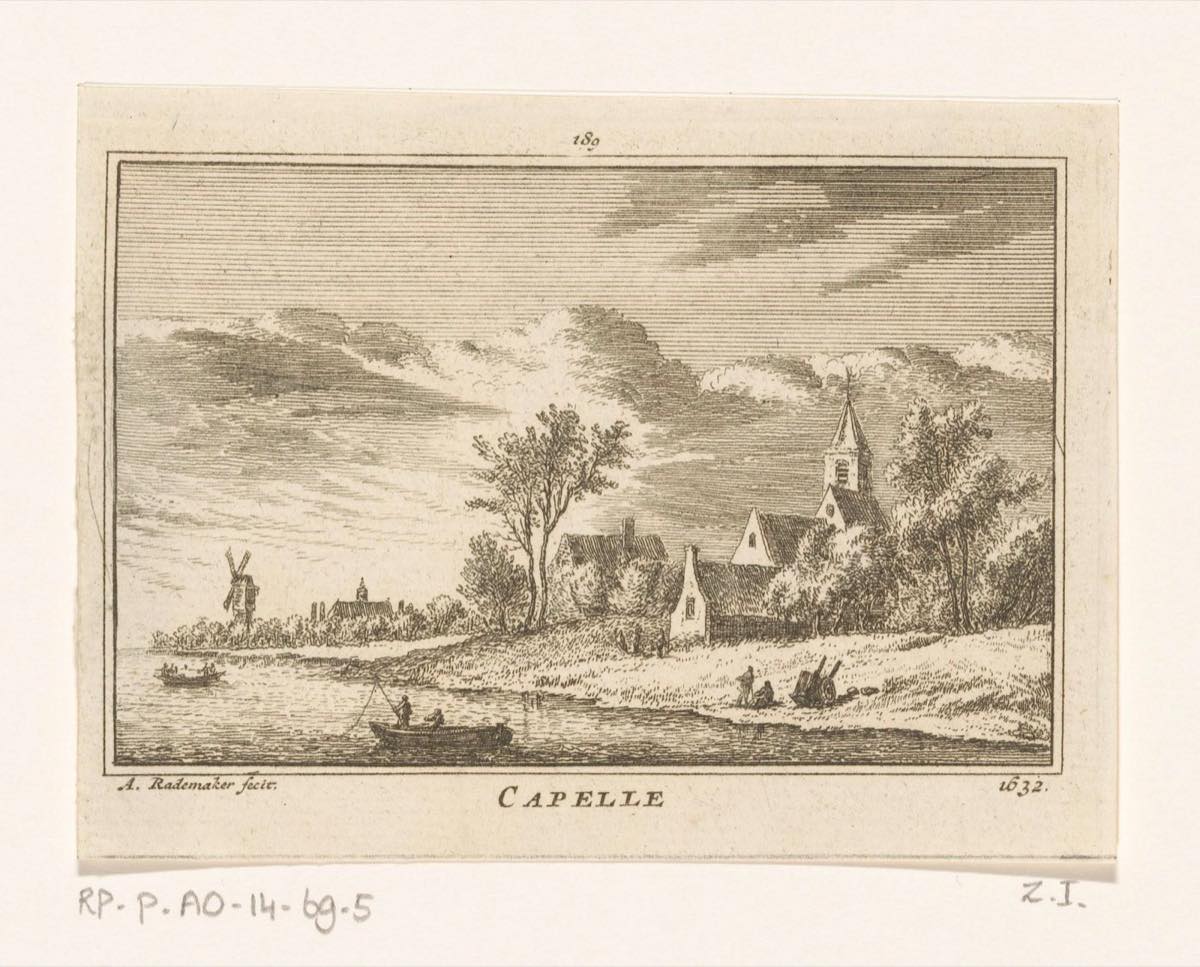
Capelle aan den IJssel has always been a dyke village. For centuries it was a narrow row of houses and farms along the Hollandse IJssel — a village that lived mainly off the water. In the Middle Ages people cut peat from the bog, which went as fuel to Rotterdam and the surrounding region. Residents always had a lot to do with water: drainage, dyke maintenance, shipping. The print above shows Capelle in 1632, much as it would look until late in the nineteenth century.
In the nineteenth century industry came to the IJssel: brickyards, carpentry yards, eventually shipyards. The most famous was that of Adrianus Vuyk, who opened his yard on 15 December 1872. Scheepswerf A. Vuyk & Zonen would last more than a hundred years, until 1979, building hundreds of vessels — from inland barges to small coasters. Around those yards a working community of dyke residents, carpenters, smiths and fitters developed.
The real growth came after the Second World War. In 1945 Capelle had about 5,000 inhabitants, mostly along the old dyke ribbon. Then it had to absorb what Rotterdam could no longer fit, and within three decades it grew to over 57,000 inhabitants. The neighbourhoods Schollevaar, Oostgaarde, Fascinatio — those are the building periods of the 1960s, 70s and post-2000. Driving through Capelle today, you still see the old dyke village, framed by a city ring built rapidly around it.
Capelle today is a suburb with city qualities: densely populated, well connected, lots of families. We drive set pickup days through the municipality — Schollevaar, Oostgaarde, Dorp, Schenkel. Your bag is ready in the morning, and comes back in the evening clean, ironed and folded with the same driver. That's how Wastas works in Capelle — from dyke to high-rise, the same round every week.
How Wastas works in Capelle aan den IJssel
On the set pickup day our driver is at your door. Clean laundry comes back by appointment — folded or on hangers, however you like it.
Other municipalities nearby
Sign up in two minutes and schedule your first pickup.