

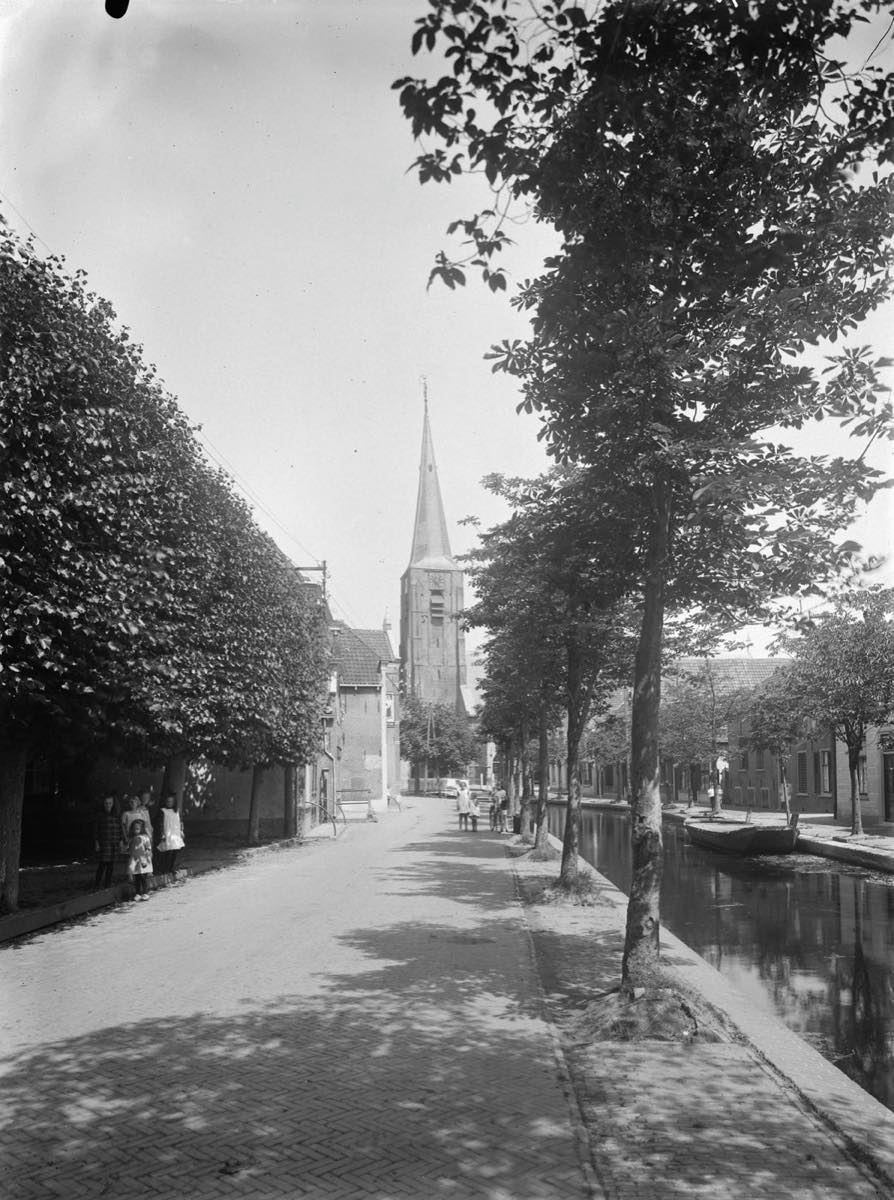
Maasland is more than just a village in the Delfland polder. As early as 1494 it had 250 hearths — a respectable size for the time. A third of the population lived from fishing and transport: Maasland lay close to the Maas, with a busy waterway that emptied via the Gaag and the Vlaardingervaart into the river. The other two-thirds farmed and raised cattle on the surrounding polders.
The village sits at an important water spot. In 1289 Count Floris V officially recognised the Hoogheemraadschap Delfland as the water-management authority for this entire area. Around 1380 the manors of Maasland, Naaldwijk and Voorburg jointly decided to dig a new waterway — the Boonervliet — to drain surplus water from the polders to the Maas. It is still a main canal in Delfland. The photo above, by Cornelis Johannes Steenbergh in the early twentieth century, shows the village with the Reformed Church at the canal.
For centuries Maasland was independent. In the great municipal reorganisation of 2004 it merged with Schipluiden into Midden-Delfland. Despite that merger the village has kept its own character: a compact core around the church, with farms within walking distance, and the Boonervliet as a visible reminder of how this area has managed its water for centuries.
We run set pickup days through Maasland, including the hamlets along the Commandeurskade and Zuidbuurt. Your bag is ready in the morning, and in the evening it's back at your door clean and ironed — same driver as last week. Nothing more complex than that; it does save you an evening. That's how Wastas works in Maasland — on the Boonervliet that has shaped the water and the rhythm here for seven centuries.
How Wastas works in Maasland
On the set pickup day our driver is at your door. Clean laundry comes back by appointment — folded or on hangers, however you like it.
Other municipalities nearby
Sign up in two minutes and schedule your first pickup.